08 November 2012

What next, Mr. President?

The President waves to the crowd before his 2012 acceptance speech.


    On Nov. 6, Barack Obama secured a second term as President of the United States of America. While I congratulate Obama on his victory, I must ask: what exactly, Mr. President, will you do in the next four years?
    The focus of Obama’s reelection campaign was the economy, so it is reasonable to assume that he will make strengthening the economy his top priority. The centerpiece of the President’s first-term economic policy was the American Recovery and Reinvestment Act (i.e. the stimulus), which made long-term investments in infrastructure, green energy, education and manufacturing. Obama plans to enact another, smaller stimulus in his second term, named the American Jobs Act, which will cut income and payroll taxes and increase infrastructure and education spending. The rest of his economic plan consists of an overhaul of the tax code and investments in energy. Obama promises to raise the capital gains tax (a tax on investments and stocks held for more than one year that primarily affects the wealthy) from 15 to 20 percent and to raise taxes on the top two tax brackets from 33 and 35 percent to 36 and 39.6 percent, respectively. His tax plan also includes promises to eliminate loopholes and to streamline the tax code for businesses and individuals. The plan specifies to phase out loopholes for those with incomes over $200,000 and to eliminate several loopholes for large companies, although how it plans to streamline the tax code remains unclear. He also aims to create or extend numerous tax credits for individuals and businesses, such as a $3,000 credit per each worker hired for businesses, cut the corporate tax rate, eliminate the current tax credit for outsourcing and extend the Bush tax cuts and other tax cuts and credits for individuals making less than $200,000 per year.

The President’s energy policy in his next term will be similar to his first term’s energy policy. Obama plans to focus primarily on funding alternative energy while also expanding access to cheap hydrocarbons. He aims to raise fuel efficiency requirements for vehicles, set a requirement that all utilities must produce 80 percent of their electricity by 2035, continue funding and supporting the alternative energy industry and increase gas, oil and coal production by opening up some public lands to drilling and encouraging hydraulic fracking (a new, controversial type of natural gas extraction) while insisting on higher environmental safeguards for drilling and fracking.
    For the President, economic policy and fiscal policy dovetail, which is why he has proposed a plan for cutting the deficit. His plan for reducing the deficit centers around an 80-page deficit reduction plan that he drafted in 2011. Obama calls for raising taxes on the wealthy by eliminating the capital gains tax, raising marginal income tax rates and eliminating loopholes for the wealthy. The plan also incorporates spending cuts. Obama plans to cut $257 billion from discretionary spending, primary by cutting subsidies to agriculture and the oil industry. He will also cut $450 billion from the defense budget, try to cut Medicare’s budget by negotiating with pharmaceutical companies to lower drug prices and to levy an additional Social Security tax of 2-4 percent on those with incomes over $200,000 to try to make Social Security solvent, among other things. According to the nonpartisan Congressional Budget Office (CBO), this budget will cut the debt by $2 trillion and increase GDP growth by 0.6 percent, although the President’s opponents point out that his budget adds $4 trillion to the deficit when compared to the CBO’s baseline budget, which includes the expiration of the Bush tax cuts and sequestration (an imminent series of spending cuts). Despite his willingness to cut the deficit, Obama has stated that he will try to prevent the impending “fiscal cliff” (i.e. the impending combination of the expiration of the Bush tax cuts and sequestration), which is projected by the CBO to put the economy back into recession. Like much of Obama’s economic policy, however, his deficit plan is unlikely to pass through the Republican-controlled House.
Indeed, because the Democrats do not control Congress, the only thing that Obama can be guaranteed to do in his second term is to cement the achievements of his first term. Two of his main accomplishments, the Dodd-Frank Wall Street Reform and Consumer Protection Act (Dodd-Frank), a banking and financial sector reform law and the Affordable Care Act, still have major provisions that need to be implemented. The main achievement of Dodd-Frank was to require regulatory agencies and new committees set up by the law to draft and enact certain regulations of the financial sector. Only one-half of these rules have been drafted however, so Obama will have to fight to get the rest of the regulations drafted. Similarly, most of the important provisions of the Affordable Care Act, including the individual mandate and the ban on gender discrimination by insurance companies, will be enacted in 2014. Since several states are already trying to fight these provisions through both legislation and governor decree, Obama will have to fight, using the courts, personal influence over state governments and possibly legislation, to ensure that the main provisions of healthcare reform get enacted.
On social policy, Obama supports gay rights, gender equality and immigration reform. The most important social policy for Obama is women’s rights, judging by the amount of focus he placed on it in his first term. The President aims to expand free contraceptive access to women, pass the Paycheck Fairness Act, which aims to make it easier for victims of wage discrimination to discover if they are being discriminated against and to seek justice and to try to pass other bills that combat sexual violence and wage discrimination. The President believes that women should be allowed to get abortions, so he will likely oppose potential legislation that restricts access to abortions, both in Congress and at the state level. In terms of gay rights issues, Obama supports legalization of same-sex marriage, although how he plans to achieve this is unclear, as it can only be accomplished by amending the Constitution. He also plans to enact the Employment Non-Discrimination Act (which bans hiring discrimination based on sexual orientation and gender identity) and repeal the Defense of Marriage Act, which defines marriage as between a man and a woman for federal purposes. On the issue of immigration, the President’s platform notes his support for reforming and streamlining the immigration process, although his platform lists no explicit reforms. He is a noted supporter of the DREAM Act, which would provide illegal immigrants who are students or soldiers in America with permanent residency status, and he would probably make trying to pass the DREAM Act his biggest goal as far as immigration is concerned. Since he has described his failure to pass the the DREAM Act as the biggest failure of his first term, it is reasonable to expect that he will make pushing for the DREAM Act one of his top priorities in his second term.
Although Obama fought for all of these issues in his first term, the extent to which he would be able to achieve them in his second term is limited due to both the limited Constitutional role of the President and the fact that the House is controlled by Republicans. The most important way that Obama can influence social policy is through whom he appoints to the Supreme Court. Four justices are in their late 70s and are thus likely to retire. The Court, which is split 5-4, is set to rule on cases concerning the constitutionality of the 1968 Civil Rights Act, the Defense of Marriage Act, the constitutionality of affirmative action and California’s Proposition 8, among other important social issues, so who Obama appoints to the Court will have long-lasting effects on social issues.
The foreign policy of Obama’s second term, like his first term, will be centered on slowly ending the War on Terror while preparing to face other, more long-term threats. Obama’s primary foreign policy challenge in his next term will be to ensure that the 2014 withdrawal from Afghanistan goes well. The success of the withdrawal will be contingent on whether Afghan security forces are able to fight terrorism on their own in 2014 and whether the Afghan government will be able to become functioning, strong and non-corrupt, so the President will likely focus on making these things happen in his second term. Even after the Afghanistan withdrawal, Obama will have to continue to fight terrorism. He will probably continue his policy of drone strikes in Pakistan and Yemen, and will have to manage the backlash and opposition that they generate, although he has offered no specifics.
The President’s primary foreign policy plan is to shift American power away from the Middle East and towards Asia. The centerpiece of this effort will be to continue the “pivot” to Asia, which is the rebalancing of American power (especially military power) towards East Asia and especially China. The President promises to shift 60 percent of our military strength to Asia by 2020, an effort that is already underway, and to attack China’s allegedly unfair trade policies, although he probably will not do so due to the risk of starting a trade war. He also will likely reach out to American allies in East Asia, especially India, and continue to invest in military hardware for South Korea and Japan. Unfortunately, he has offered few specifics on other major foreign policy issues, including Iran, the rise of the BRICs (Brazil, Russia, India and China) and the economic crisis in Europe. Judging from his first-term’s record, Obama will likely try to reach out to Brazil and India, increase sanctions on Iran while continuing both covert military actions against Iran and create efforts to find a diplomatic way to remove Iran’s nuclear weapons and ignore the crisis in Europe.
Barack Obama has a difficult four years ahead of him. He will have to fix the economy, prevent the deficit from spiraling further out of control, protect the rights of minorities and refocus our foreign policy towards long-term threats, all while having to battle strong Republican opposition in Congress. I wish him good luck. He’ll need it.

18 September 2012

We gave up in Afghanistan today

An American medic treats a wounded French soldier in Afghanistan.

Something huge happened today: we gave up in Afghanistan. This was a long time coming. American interest in the war has fallen substantially and is now nearly non-existent. The Republicans did not mention the war at their convention (Clint Eastwood's mention of Afghanistan in his speech, the only mention of the war in the Republican convention, does not count) and devoted just part of a paragraph to it in their platform while the Democrats mentioned the war just once at their convention. The war receives just two percent of all news coverage. Although everything from the high price and difficulty of the covering the war to the complexity of the conflict (which makes it too difficult for most Americans to understand), the main reason the war is not featured in the media is simple: people just don’t care about it. Three-fourths of Americans disapprove of the war, and almost none rank it as the most important issue in the Presidential election. Even the government is ignoring the war. Because of its unpopularity, the war in Afghanistan is ignored by the President. The most popular solution, speeding the withdrawal, is militarily impossible: the Afghan army is not ready to maintain order in Afghanistan or combat terrorism, evidenced by its systemic corruption, its failure in counter-terrorism operations (specifically in the Helmand region), and, most importantly, the huge number of green-on-blue attacks that raise questions about the loyalty and cohesiveness of the Afghan force. The President knows that he is in a double-bind: succumbing to popular opinion would lead to a partial collapse of the Afghan state at best and a Taliban resurgence at worst, neither of which would go over well with voters, while dragging on the expensive and bloody war is unpopular. The best solution for the President is to thus keep the war out of the spotlight, where it cannot hurt his chances for re-election.

All of this collective disgust with the war and ignorance towards it has an effect on the situation on the ground. The President’s sole focus in Afghanistan has, for the past year, been trying to end the war as quickly as possible. The entirety of the Afghanistan section in his platform is devoted to reminding the American people that he is orchestrating the withdrawal of American forces from the country. Indeed, his entire line of attack against Romney in his platform is that Romney “has suggested he would leave [American troops in Afghanistan] indefinitely.” The consequences of this have been his decision to publicly announce the withdrawal timeline (which is very useful for the Taliban because it gives them a clearly defined schedule for preparing to reconquer Afghanistan, a schedule that yesterday’s massive, complex attack on “impregnable” Camp Bastion proves they are following) and to leave no troops in Afghanistan after the deadline, which could contribute to instability there if the Afghan army is not ready by 2014, as now looks probable.

The president’s strategy vis-a-vis Afghanistan is now shifting to include another aim: keep the war out of the spotlight. This shift in strategy is best illustrated by today’s announcement that man-on-man training of the Afghan army, which is more effective than training in huge groups (think of the benefits of learning from a tutor over learning in a huge lecture hall), will be ended. This will surely reduce number of American casualties (which will also reduce the amount of news coverage the war receives), but it will make the Afghan army less effective. Although it can be argued that Obama is simply showing concern for our troops, we have to keep in mind that the point of sending soldiers somewhere is for them to go into harm’s way. While it is very generous of Obama to care for American troops, it runs counter to the point of deploying soldiers somewhere in the first place.

It’s hard to place the blame on Obama for America’s failure to fully commit to Afghanistan because it is brought on by the American people’s apathy and disgust towards the war. Mitt Romney’s vague plan for Afghanistan, which consists of little other than a promise to provide security in South and Central Asia (that’s about as specific as if he made his China policy “interact with China”) and a criticism of Obama’s public announcement of the withdrawal timeline. If we want to see change in our Afghanistan policy, we need to take interest in the war. We can’t have both a speedy withdrawal and a low-intensity war. We have to ramp up troop training efforts and supervision of the Afghan forces if we want order to stay in the country. Bases for drones and special operations will have to stay past the 2014 deadline in the likely event that terrorism threatens the Afghan government. We may even need to do a top-down restructuring of the Afghan government and military to root out corruption and diffuse power from the current elite to include more ethnic groups. Will this take a lot of effort and resources? Of course. But we have committed far too many resources to Afghanistan to simply half-ass the final, crucial transition and waste our 11 years of hard work there. Afghanistan is not just some backwards hellhole that we invaded in an imperialist fit of post-9/11 rage. It is a resource rich energy hub that, if its natural gas and minerals are exploited and the proposed pipelines through there are built, could change the balance of power in Asia depending on which country, China or India (or both or neither) exploits it first. It is a key piece in the struggle between India, a rising superpower, and Pakistan, an important player in the War on Terror, that shapes all of our interactions with South Asia and most of our policy towards the Indian Ocean. And, finally, it has the potential to become a terrorist base once again, which would allow for Al-Qaeda to launch another mass casualty attack on the American mainland. Afghanistan is still crucial to our country’s security, and if we give up now, all our resources spent their will be wasted. If the American public puts pressure on the Administration to go whole hog in Afghanistan, we may yet succeed. It is not yet too late.

13 September 2012

Saving Europe with Natural Gas

Courtesy CartoonStock.com

On New Year’s Day, 2009, a dispute over payment between Russia and Ukraine led to Russia cutting off all Ukraine bound gas, which included 25 percent of the European Union’s gas supply.1 To make things worse, Europe was in the middle of an especially harsh winter. Even though most countries had prepared for a gas shortage by stockpiling natural gas, their efforts were not enough, as few European countries had more than a month’s worth of reserves, and many lacked any reserves. The crisis hit Europe hard: Bulgaria was forced to shut off industrial production to save fuel for heating, thousands lost heating and electricity, and tiny Slovakia even declared a national state of emergency.1
This is not an isolated event. Russia has halted Europe’s gas supply in 1999, 2006, 2009, and 2012, each time in the dead of winter. The 2009 shortage cost €1 billion in Ireland alone2, and the 2012 shortage caused 650 deaths in Central and Eastern Europe.3 Although the EU as a whole gets only 31 percent of its gas from Russia, many Eastern European countries get 90-100 percent of their gas through Ukraine, and Germany, the EU’s de facto leader, gets 42 percent.4 Besides denying thousands of people heat for the homes and offices and severely injuring economies, these gas crises have broader geopolitical implications. Ukraine gave half the ownership of its gas pipeline, its biggest source of revenue, over to Gazprom (the Russian state-owned energy agency) after the 2009 crisis. Further, Russia took over most Ukrainian mines and power stations, has sent in many Gazprom security police to guard the pipeline (actually heavily armed soldiers and drones), boosted cooperation between Russian and Ukrainian defense ministries, has secured not only a more favorable Ukrainian government but also a much longer lease on its critical Black Sea base in Sevastopol, and, most ominously, has begun implementing political reforms in Ukraine to make Ukraine more like Russia. Russia has also exploited the total reliance of Eastern Europe on Gazprom’s natural gas in mid-2009 when it set up a number of security and economic alliances that heavily favored Russia (think Warsaw Pact part II).5 When Turkey lost 67 percent of its gas in 2009, it cozied up to Iran to get gas from them. Turkey helped Iran build a major pipeline through Turkey, a pipeline that until very recently continued to operate despite sanctions on Iran.
Further, Russia is not nearly as dependent on the EU as the EU is on Russia. Russia is building new pipelines to China and the Koreas, and has recently completed pipelines to China in 2010, and to Turkey and the Caucus region in 2006.6, 7, 8 Demand from Turkey and China nearly equals demand from Europe,8 meaning that Russia can make up lost gas revenues from Europe by simply increasing gas supply to other countries.
Europe’s reliance on Russian gas stems largely from the fact that Europe has little gas of its own. However, it seems puzzling that European nations continue to rely on authoritarian and unpredictable Russia in light of recent events in the gas market. 2011 was a record year for U.S. natural gas production, which now outstrips domestic demand by 119 billion cubic meters.9 This is excess is far greater than European demand, which currently amounts to 65 billion cubic meters.1 American shale gas is cheap, too: it is at the lowest price in a decade. This boom and low price is largely attributable to recent advances in shale-gas mining techniques that have opened up billions of cubic meters of gas up to drilling.10 Exporting this excess gas to Eastern Europe would be beneficial for gas companies and U.S. foreign relations: gas companies would make greater profits while the U.S. would keep Eastern Europe out of Russia’s sphere of influence. Further, Europeans citizens would benefit from U.S. gas: American natural gas costs $30 per 1,000 cubic meters11, while Russian gas shipped to Western Europe costs $500 per 1,000 cubic meters and gas shipped through Ukraine costs $250 per 1,000 cubic meters.12 If natural gas prices were lowered this dramatically, Europe’s economic recovery would speed up rapidly.
 
So what is it that stops the U.S. from exporting more gas to Europe? As usual, the answer is money. Natural gas must undergo an expensive liquefaction process before sea transport, while it can be left in its natural gaseous state for pipeline transport. Further, after a sea journey, natural gas must be regassified, a process that can only be done at expensive terminals that usually cost more than $1 billion13 to build.
In the long run, it is worthwhile to make investments in building regasification terminals in Eastern Europe because the expected monetary payoff to gas companies and political payoff to the U.S. government is so great. In the short term, however, stop gap measures must be taken. The U.S. can assist European nations in acquiring machines called floating regasification and storage units (FSRUs), natural gas tankers converted to serve as regasification terminals. FSRUs can be leased for an average of $70 million per year, an inexpensive price considering that one FSRU can regassify 3.4 billion cubic meters of natural gas, or 125 percent of Lithuania’s natural gas consumption. FSRUs are also much quicker to build than regasification terminals. Already, Lithuania, one of the first European countries to lease an FSRU, has seen its negotiating power with the Russian leadership increase after it leased its FSRU earlier this year.14
To do its part, Europe can start developing its own shale gas reserves and diversifying its gas sources. The EU sits on 2.168 trillion cubic meters14 of accessible natural gas. If the EU were to build facilities for extracting this gas, it could hypothetically eliminate the need for foreign supplies of gas. Further, the EU could turn to other sources of gas, such as Qatar or Mozambique, both of which have made enormous natural gas discoveries recently.15
The process of weaning Europe off of Russia’s teat may be dirty and expensive. But the end result, a steep drop in Russian influence in Europe, particularly Eastern Europe, will be enormously valuable from a geopolitical standpoint. Once Russian influence is no more in Europe, true integration of Eastern Europe into the EU and the Schengen Area can begin, which will further bolster the EU and make it an effective counterweight to Russia. This would be particularly beneficial for the U.S., which has a prime opportunity to accelerate the recovery by bolstering the natural gas industry and to weaken its old foe. America would be a fool not to take it.


 Citations
1.. "FACTBOX - 18 countries affected by Russia-Ukraine gas row." Reuters 7 Jan. 2009:
    n. pag. Web. 13 Apr. 2012.
"Natural gas shortages slam many European nations." Tuscon Citizen 7 Jan. 2009: n. pag. Web. 13 Apr. 2012. .
2. Leahy, Eimear & Devitt, Conor & Lyons, Seán & Tol, Richard S. J., 2011. "The Cost of Natural Gas Shortages in Ireland, "WP397, Economic and Social Research Institute (ESRI).
3. Murray, Alina. "Cold Weather Snap in Eastern Europe Kills More Than 650." MSNBC 2 Feb. 2012: n. pag. MSNBC. Web. 13 Apr. 2012.
4.European Union. EU-Russian Gas Relations in Perspective: Challenges and Opportunities. N.p.: European Dialogue, 2012. European Dialogue. Web. 13 Apr. 2012. . 
5. United States. U.S. Army. Russian Influence on Ukrainian Strategic Policy. By Defek G.
    Webb. Charleston, SC: U.S. Army, 2011. Print. 
6. Stnagarone, Troy. "Russia's North Korea Gas Deal." The Diplomat 15 Nov. 2011: n. pag. New Leader Forum. Web. 13 Apr. 2012. . 
7. British Petroleum. “Southern Caucasus Pipeline overview."
8. Reuters. "New Russian pipeline replaces oil by rail." Global Times 10 Dec. 2010: n. pag. Global Times: Discover China Discover the World. Web. 13 Apr. 2012.. 
9. United States. Energy Information Administration. Natural Gas Overview. N.p.: Energy Information Administration, 2012. Department of Energy. Web. 13 Apr. 2012. 
10. Osborne, Andrew. "Why natural gas is cheap and gasoline isn’t." New York Times 30 Mar. 2012: n. pag. NYT. Web. 13 Apr. 2012. .
11.United States. Energy Information Administration. Quantity and Average Price of Natural Gas Production in the United States, 1930-2000. N.p.: Energy Information Administration, 2000. Department of Energy. Web. 13 Apr. 2012. . 
12. Osborne, Andrew. "Russia Firm Cuts Gas to Ukraine, But EU Hit Is Cushioned ." Wall Street Journal 2 Jan. 2009: n. pag. WSJ. Web. 13 Apr. 2012. .
13. "Lithuania leveraging a new LNG technology." STRATFOR 8 Mar. 2012: n. pag. Web. 13 Apr. 2012.
14. "European Union." CIA World Factbook. CIA, 2 Apr. 2012. Web. 3 Apr. 2012.
15.LeVine, Steve. " For Alaska (and Qatar and Mozambique and Russia) China is the hub of hope." Foreign Policy 12 Apr. 2012: n. pag. Foreign Policy. Web. 13 Apr. 2012.

12 September 2012

Christopher Stevens: In Memorandum

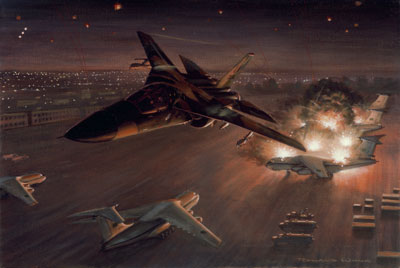
An artist's depiction of Operation Eldorado Canyon, in which U.S. aircraft attacked state terrorists in Libya with a single, high-firepower airstrike. Obama's response to the death of Christopher Stevens strongly resembles this operation.
 
The death of Christopher Stevens, the American ambassador to Libya, is a tragedy. That, hopefully, should be agreed upon by everyone. This tragedy should help us reflect on both how we interact with the world and how our counter-terrorism strategy is evolving.

We must first be clear about what happened in Benghazi. Crowds in Libya and Egypt attacked U.S. consulates roughly simultaneously. The mobs in Libya and Egypt were protesting over an internet video titled "Muhammed Movie Trailer" released by an Israeli-American Jew. The 14-minute video is an untrue, libelous and sick assault against the founder of Islam. Muslims thus ought to be disgusted by this video. The protests at the U.S. consulates seem to have been sparked by the belief that this video was broadcast on the American mainstream news media and that it reflected the beliefs of most Americans. Both of these beliefs are of course false, but what matters is not whether they are true, but how they came to be believed. It appears that an activist leaked the video to a reporter, who in turn spread it via Facebook to Libya and/or Egypt, where it quickly spread and went viral. Although the crowd in Benghazi that protested outside the U.S. Consulate was never peaceful (they scaled the consulate wall and burned an American flag), they were not what did Stevens in. The protest was infiltrated by insurgents, who attacked Stevens and his entourage with a rocket propelled grenade and automatic weapons. The insurgents possibly have links to Al-Qaeda, according to the Wall Street Journal.

There are a few things that are significant about this event. First, the fact that an insignificant video can be seen by thousands of Muslims as representative of prevailing American culture speaks to the fact that the U.S. has an image problem. Here, it is apparent that this image problem is not, as some claim, a result of the fact that the U.S.' primary means for interacting with the world is through its military. While it is true that America's main way of interacting with her enemies and neutral countries is through military force (or threats and shows of force), we no longer live in an area where states are the main global actors. Instead, groups of people, from Libya's National Transitional Council to the protestors in Tahrir Square to Al-Qaeda, are the main actors in the world. Most global individuals interact with the U.S. in one of two ways: through our culture (which includes not only our values, but also how we convey those values e.g. entertainment and the media) and our economy, namely through multinational U.S. corporations that sell to all nations, although the former is clearly more influential. While it is idealistic and pretty hopeless to ask the media to tone down the Islamophobia in order to protect American lives, it is the only real solution.

In remarks following Stevens' murder, Obama stated that he would "avenge" Stevens' death. Obama gave us a pretty clear indication of what he meant by that: two Arleigh Burke-class destroyers, heavily armed warships designed for air defense and high-volume bombardment, were deployed to Libya. U.S. drone aircraft have also been spotted in Eastern Libya, where the attack took place. So Obama is planning to crush Stevens' killers with overwhelming force. The unilateralism of this operation and its reliance on a single, highly visible usage of heavy firepower (in contrast to a protracted counter-insurgency campaign like Afghanistan or a lower-profile targeted operation like the U.S. operations in Pakistan) seem reminiscent of the approaches Reagan and Clinton took to counter-terrorism, namely to the Eldorado Canyon operation in Libya and the attack on Tora Bora under Clinton. Does this mean that Obama is changing his counter-terrorism strategy from targeted killings to overwhelming force? Probably not, since deterrence by force (aka "shock and awe") has clearly not worked against Al-Qaeda. However, it is important to keep in mind that the the insurgents who carried out today's Benghazi attack are representative of the new face of global Islamic terrorism: local groups operating under the banner of Al-Qaeda to increase their publicity and get support from both foreign donors and local recruits. With that in mind, it seems that Obama is trying to send a message to these Al-Qaeda-inspired groups, many of whom have less resolve than Al-Qaeda itself (compare how much longer Al-Qaeda in Pakistan has held out to how long Al-Qaeda in Nigeria and the Philippines have held out): if you associate with Al-Qaeda at all, you will be wiped out. If this strategy is successful, which it probably will be since it relies on basic, tested theories of deterrence, it will mean the end of global terrorism, and thus of the ability of terrorist organizations to conduct global operations like 9/11. However, it will also serve to drive local terrorist groups, especially the less dedicated ones, underground, decreasing their effectiveness. While this would make it more difficult to root out these organizations, it would also take away our rationale for doing so: that they pose a threat to our security. In other words, if this strategy and Obama's current targeted killing strategy aimed at Al-Qaeda's leadership work, it will mean the end of global Islamic terror. Let's hope it works.

12 August 2012

Ryan: a big shift to the fiscal theater


Courtesy Gateway Pundit
I thought I would just throw in my two cents about Mitt Romney's VP pick of Paul Ryan. It seems clear that Romney is picking Ryan for two reasons: to offset his political inexperience and to shift the conversation towards the deficit.

Romney's primary reason for picking Ryan is to acquire a Washington insider. Although Romney does have some political experience, namely his governorship of Massachusetts, he has no experience on the national level. As he has tirelessly reminded Americans, he is a corporate man, not a career politician. While this may sell well to most Americans, who still view the private sector in a better light than the government, it means that Romney is unfamiliar with the nuances of political speech. He speaks bluntly and honestly more often than he should ("I like being able to fire people"), and is notorious for saying the wrong thing to the wrong crowd (insulting London on its Olympic performance while in London). Ryan, by contrast, has been in Congress since 1999. He is very familiar with political speech, and will probably help Romney cut down on gaffes.

The other reason for picking Ryan is to shift the focus of the campaign. This election has been a referendum on Obama's economic performance, as both candidates have made clear. Ryan's main claim to fame, however, is not his performance on the economy, it is his controversial budget. He is routinely described as a "deficit hawk." Romney's pick of Ryan seems like an attempt to shift the focus of the campaign from the economy to the deficit.

12 June 2012

Militarism 2.0: South China Sea

Chinese destroyer Qingdao enters Pearl Harbor in 2006. The fact that she was able to make this long journey demonstrates the high endurance of Chinese warships.
A specter is haunting Asia – the specter of war. Across the continent, from India to Japan, formerly peaceful countries are pursuing aggressive and occasionally expansionist policies. While expansionism is not new in the region, this time is different. Previous conflicts in Asia tended to feature one modern and well-armed nation conquering smaller and weaker ones, as in the rise of Tang China in the 7th century or Imperial Japan in the 20th century. This time, however, there are several different sides involved in a potential run-up to war. Aggressive statements from political leaders are just the public face of the looming crisis. The region is haunted by nationalism, energy disputes, and, most ominously, an arms race.

Arms Race

Since the Pacific and Indian Ocean regions are defined by the sea, this arms race is primarily naval. Although military spending in Asia grew at a slower rate than usual because of the poor state of the economy, Asian military budgets grew by an average of 2.3 percent in 2011.1 While this may not sound like a very large increase, it is significant because military spending in the rest of the world has hit a plateau, which makes Asia the region with the second biggest increase in military spending, after the Middle East.2 Asia’s military buildup is more visible over the long term, as spending has risen 69 percent since 2000, compared to a global increase of 49 percent.3 This is especially concerning because the U.S. and most of its Western European allies are cutting their defense budgets to rein in rising deficits.4

The two countries largely responsible for this jump in spending are also the world’s largest: India and China. By 2030, India plans to spend $45 billion on its navy and add 103 ships to its fleet; China plans to spend $20 billion and add 135 ships. India is the world’s largest arms importer, accounting for nine percent of all global arms trade.5
   
More important than just the numbers of ships India and China plan to acquire, however, is the types of ships they will build and weapons they are buying. Both countries have explicitly stated a desire to own “blue-water” navies,” (fleets that can fight and project power more than 200 miles from their home countries) and are thus investing in power projection weapons, particularly aircraft carriers. India is currently building two new 40,000 ton carriers, is planning to launch a 65,000 ton carrier by 2017, and has purchased $700 million worth of MiG-29ks (Russian carrier-based fighters).6 China, meanwhile, has just launched its first carrier, a refitted 33,000 ton Gorbachev-era ex-Soviet vessel and plans to build four more.7

 
Carriers are useful for projecting influence and fighting conflicts a long distance away from their bases, which makes them exceptionally well suited to power projection and controlling regions. It is worrying that China and India are expressing increased interest in these vessels, since it shows that they likely intend to establish firm spheres of influence in the region using threats of force.
American and Indian aircraft fly over the Indian aircraft carrier INS Viraat.
India and China are interested in another power projection tool recently: amphibious warfare ships, which can transport Marines and launch D-Day style assaults on beaches. India bought its first amphibious warfare ship, an outdated U.S. Navy vessel, last year and plans to acquire four newer ships,8 and China owns two modern (circa 2006) and domestically built amphibious warfare ships and plans to build eight more.9
   
Both nations are also investing in the crucial yet inconspicuous aspects of power projection: support vessels (underway replenishment ships, oilers, tankers, etc) and foreign bases. The Indian Navy has just acquired two new tankers and two underway replenishment and ammunition ships, and it has reportedly conducted underway replenishment operations.10 China has owned an extensive fleet of tankers and support ships since the ‘90s and has been stepping up the rate of exercises involving them after 2005.11 Much has been made of China’s “string of pearls,” a string of new naval bases and deepwater ports from Pakistan and Sri Lanka to Myanmar and Cambodia.12 While the Indian Navy does not yet have as many bases as China, it has built a new base in Madagascar, has berthing rights in Oman and Vietnam, and is negotiating with the Maldives to build a base there.13

Although most emphasis is placed on construction of power projection weapons, offensive weaponry is also being stockpiled by both nations.
India and China are building fleets of modern, stealth frigates and destroyers. These new surface ships are heavily armed and carry some of the most advanced electronics, including Active Electronically Scanned Array radars, which are nearly impossible to jam and can track far more targets than regular radars.14 The most important aspect of these new ships, however, is that they are high endurance: China’s Type 052 destroyers have a range of 4,000 nautical miles15 and India’s Delhi class have a range of 5,000 nautical miles.16

           Acquisition of silent diesel-electric submarines and better armed nuclear submarines, both of which are purely offensive weapons, is also a priority for both countries. India is currently buying the latest submarines from Germany and Russia and is planning to launch 30 new boats by 2030,17 and China has added 42 boats of increasing stealthiness to its fleet since 1995, and expects to add a total of 75 boats by 2020.18

Finally, both countries are upgrading their missile inventories: India has equipped all destroyers and frigates with the stealthy, supersonic, mid-range (290 km), and powerful (armed with a 300 kg warhead) BrahMos missile. It is also deploying the short-range Dhanush ballistic missile, which is armed with either a 500 kg armor piercing warhead that can be used against ships or a 10 kiloton nuclear weapon, onboard its submarines and patrol craft.19 China has built the famed DF-21D, the world’s first ballistic anti-ship missile, which has a staggering 1,500 km range and is considered a serious threat to U.S. carriers.20 China has also acquired hundreds of regular anti-ship cruise missiles, including the Russian SS-N-27N Sizzler which an American admiral has said the U.S. Navy has no known defense against, as well as several satellites to guide long range missiles and air operations.21

Almost all Asian countries have found themselves forced to respond to this arms race. The three making the most significant fleets, other than India and China, are South Korea, Japan, and Russia. South Korea is planning to build 128 ships by 2030, although some of those are just replacing outdated vessels.22 Despite its constitutional ban on war, Japan has the strongest navy in the Pacific region, and it is investing heavily in new fighters, expensive anti-ballistic missiles (ABMs), networking technology, and additional “helicopter destroyers” (a euphemism for aircraft carriers). In 2010, Japan announced that it would build its first foreign base since WWII, a navy base in Djbouti, on the Indian Ocean.23 Russia    China, Vietnam, and the Philippines is in the process of modernizing its navy to include two new amphibious assault ships, a new class of ballistic missile submarines (the largest ever built), and over 20 stealthy anti- aircraft frigates and corvettes. The Russian Navy’s latest strategic guidance document makes it clear that the focus of this buildup is the Pacific region, and most of the new ships will be deployed to the Pacific.24

The arms buildup is affecting all countries both in the heart of the region and far away from it; a few examples of this are listed below. The Royal Australian Navy, in the words of Australian Vice Admiral Ray Griggs, plans to “[Evolve] into a much more capable amphibious force, [bring] new air- warfare destroyers into the fleet, and [double] the size of the current submarine force,” in addition to plans to acquire the advanced and stealthy F-35 fighter and to potentially buy American Virginia-class nuclear submarines.25 Pakistan, understandably unnerved by the naval buildup conducted by its longtime enemy India, is investing in new basing infrastructure, more ships, and space and cyber weapons.26 Indonesia is rapidly increasing its military spending and is adding several new vessels to its fleet, including Chinese-built missile boats and ultramodern German diesel-electric submarines.27 Vietnam has begun stockpiling Russian anti- shipping missiles and Canadian maritime patrol aircraft, in addition to buying six very quiet submarines, two frigates, and a large troop transport.28 Even tiny Singapore is modernizing its fleet with the purchase of two Swedish submarines and upgrades to the rest of its submarine fleet.29
Rising tensions

 Rising Tensions

This arms buildup is made worse by the rise in tensions in the region. Most of these tensions center around the South China Sea. Half of the world’s merchant ships, carrying about $2.5 trillion worth of oil and $2.5 trillion worth in other goods, pass through the South China sea,30 meaning that any nation with control over the South China Sea controls world trade and East Asia’s supply of oil. Throw in the fact that the South China Sea is estimated to contain about 15 billion tons of oil and natural gas plus vibrant fishing and sea salt industries, and the South China Sea becomes even more of a prize.31 Naturally, this has led to several nations, namely China, Vietnam and the Philippines claiming overlapping portions of the South China Sea.32 In terms of claiming territory in the South China Sea, China is the worst offender: it claims the entire sea, as well as what it calls the “first island chain”: Taiwan, the Spratly Islands, and the Ryukyu Islands, which are part of Japan.33 Attempts to solve the boundary dispute diplomatically in the regional ASEAN (Association of Southeast Asian Nations) forum have failed,34 which has raised tension by making Chinese officials believe that force is the only way to resolve the crisis.35

These tensions have occasionally led to crises and violence. In the most recent crisis, which is still ongoing, Chinese and Filipino warships have been in a standoff for over a month because the Philippines detained Chinese fishermen it claimed were fishing in its territorial waters. China is warning its citizens of a potential war, and has deployed five warships to the location of the dispute, including an amphibious transport dock.36 Previous disputes in the region of note include a 2010 incident in which a Chinese trawler rammed a Japanese Coast Guard ship and a 2009 incident where Chinese gunboats stalked an unarmed American surveillance vessel in the South China Sea and nearly collided with it. Notable violent clashes include a 2005 incident in which two Chinese warships fired on Vietnamese fishing boats China claimed entered their territorial waters, killing nine,37 and the 1974 Battle for the Paracel Islands between China and South Vietnam that resulted in South Vietnam losing a corvette and 53 sailors.38

 
Both the naval arms build up and the tensions in the South China Sea are attributable to two factors: rising nationalism and desire for national prestige in some countries, and the response to this nationalism by other nations. The best example of rising nationalism is China. The state-sponsored media regularly portrays the actions of other countries in a negative light, and occasionally calls for military action against foreigners, especially the U.S. and Japan. It tends to glorify China, and makes regular calls for reclaiming China’s “heritage” – hegemony in East Asia – from the West. Postings by Chinese civilians on social media, where nationalistic posts vastly outnumber dissident posts, even on social media not controlled by the government, show that the public buys into this sentiment.39 Japan is also experiencing a wave of nationalism,40 as very right wing candidates are gaining in power. Finally, Indian nationalism, particularly Hindu nationalism, is rising in the form of more Hindu terrorism and Mahanian calls for putting the “Indian” back in the Indian Ocean issued by members of Parliament and bureaucrats.41 Nationalism has led to a desire to assert the power of one’s country on the world stage, which partly explains the rise of aggressive, internationalist foreign policies in China and India. Most Asian nations have become alarmed by these aggressive policies and started arming, which has created the current situation.

Analysis

The United States needs to approach this situation with extreme caution. If the U.S. increased cooperation between its navy and one of its allies’ navies, or increased arms sales to an ally, it would just fuel more arms buildup from countries wary of U.S. influence tilting the balance of power in the region against them. It is thus in America’s best interest to act as a neutral arbiter in the region, deploying to any crisis zone to convince both parties to back down. Being a neutral arbiter of disputes would necessitate both strong offensive and defensive capabilities: offensive capabilities to crush the aggressors if a battle breaks out, and defensive capabilities to shield merchant vessels and allied warships from attack.

This also means that the U.S. will need to change the structure of the force it has in East Asia. Retaliation solely against enemy naval assets makes the most sense since it can quickly end a conflict without escalating it, so weapons that are primarily land-attack, namely Marines, amphibious warfare ships, and strategic bombers, should be moved out of harms way. This is why the Marine Corp’s new base in Darwin, Australia is so crucial: it is out of a potential combat zone, so troops and ships are completely safe there, yet it is close enough to the South China Sea, the heart of East Asia and the most likely location of a future conflict, that ships based there can deploy to a crisis zone quickly. If this base was expanded to include amphibious warfare ships, it could realize its full potential as a new, safe staging area for the United States in the Western Pacific.

The best policy is to not provoke war. The U.S. should pay attention to its actions in the region and be sure that they could not be seen as aggressive. However, these tensions demand a constant, strong show of force by the U.S. to prevent any armed conflicts from breaking out. However, the U.S. Navy alone has the power to police the waters of the South China Sea, cause tensions to cool down before they boil over and become wars, and protect our allies and defeat aggressors in the event of a conflict, so doing anything other than increasing American military presence in Asia is not an option.


Citations
1. “Military Spending 2011 Regional Infographic, Top 10 Military Spenders & More.” Army Technology. 16 Apr. 2012. Web. 17 May 2012.
2. ibid 1
3. “Global Fund for Women.” Militarism Facts. Global Fund for Women, 2010. Web. 17 May 2012.
4. ibid 1
5. Keating, Joshua E. “Foreign Policy.” Foreign Policy. Dec. 2011. Web. 17 May 2012.
6. Scott, David. “India’s Drive for a ‘Blue Water’ Navy.” Journal of Military and Strategic Studies 10.2 (2008): n. pag. Print.
7. Thomas, Rich. “China Plans World’s Second-Largest Carrier Fleet.” Yahoo! News. Yahoo!, 25 July 2011. Web. 17 May 2012.
8. “India Looking for Amphibious Ships.” Defense Industry Daily. 27 Nov. 2011. Web. 17 May 2012.
9. Lague, David. “Analysis: New China Landing Vessels Point to Pacific Rivalry.” Reuters. Thomson Reuters, 14 Feb. 2012. Web. 17 May 2012.
10. ibid 6
11. United States. Congressional Research Service. China Naval Modernization: Implications for U.S. Navy Capabilities – Background and Issues for Congress. By Ronald O’Rourke. 2012. Google Docs. Web. 18 May 2012.
12. ibid 11
13. ibid 6
14. AESA Radar: Revolutionary Capabilities for Multiple Missions. N.p.: Lockheed Martin, n.d. Print.
15. “Type 052 (Luhu Class) Missile Destroyer - SinoDefence.com.” Sino Defense. 1 Mar. 2009. Web. 17 May 2012.
16. India. Indian Navy. Ships in Service of the Indian
Navy. 2012. Web.
17. ibid 6
18. ibid 11
19. ibid 6
20. ibid 11
21. ibid 11
22. ibid 5
23. Werthiem, Eric. “World Navies in Review.” Proceedings Mar. 2012: 36-41. Print.
24. Fedyszyn, Thomas. “Renaissance of the Russian Navy?.” Proceedings Mar. 2012: 30-35. Print.
25. Griggs, Ray. “The Commanders Respond.” Proceed- ings Mar. 2012: 16-17. Print.
26. ibid 23
27. ibid 22
28. ibid 22
29. ibid 22
30. United States. Center for Naval Analysis. Institute for
National Strategic Studies. South China Sea Oil Shipping Lanes. Print.
31. “Rich Resources in the South China Sea.” China Oceanic Information Network. People’s Republic of China. Web. 18 May 2012.
32. Bayron, Heda. “ASEAN Meeting to Examine South China Sea Dispute.” Voice of America. U.S.A., 11 July 2011. Web. 18 May 2012.
33. Sato, Koichi. China’s territorial Claims at Sea: The East China and South China Sea. N.p.: n.p., n.d. Google docs. Web. 25 May 2012.
34. Weissmann, Mikael. “The South China Sea Conflict and Sino-Asean Relations: A Study in Conflict Prevention and Peace Building.” Asian Perspective 34.3 (2010): 25-69. Print.
35. Thearith, Leng. Is ASEAN Still Relevant? Phnom Penh: n.p., 2009. Print.
36. McElroy, Damien. “Chinese Media Warns of War with Philipppines.” The Telegraph. 10 May 2012. Web. 18 May 2012.
37. “Vietnam Protests Chinese Firing at Fishing Boats.” Intellasia East Asia News. 15 Jan. 2005. Web. 18 May 2012.
38. Ha, Van Ngnac. “Battle For Paracel Islands.” Battle For Paracel Islands. VNAF MA, 2005. Web. 18 May 2012
39. Grammaticas, Damian. “China’s Rising Nationalism Troubles West.” BBC News. BBC, 17 Nov. 2009. Web. 18 May 2012.
40. Kumagai, Hiroshi. “H. Kumagai: Rising Nationalism in Northeast Asia.” Universal Peace Federation. 17 Sept. 2009. Web. 18 May 2012.
41. Kaplan, Robert D. Monsoon: The Indian Ocean and the Future of American Power. New York: Random House, 2010. Print.

16 April 2012

Corruption in China as a force-multiplier

Reports are coming out of intense corruption in the Chinese military. These come as no surprise, since China is a highly corrupt society to begin with thanks to the unusually close relationship between government and business that characterizes Chinese state-capitalism and China's ancient tradition of wealthy nobility being awarded government positions that dates back to the Qin Dynasty in 221 BCE. Corruption in the military hampers the effectiveness of communication and lowers discipline, while corruption in the civilian government keeps millions in poverty and creating a major wealth disparity between the rich Eastern cities and the poorer yet more populous West.

On its face, this looks pretty good for the U.S. America is in the business of maintaining its hegemony, which it can do by keeping its challengers down. Corruption hurts China by hurting the Chinese economy, weakening their military, and increasing the possibility of a revolution by the poor West.

However, the U.S. has both a moral and realist responsibility to denounce corruption in China. Morally, the U.S. must denounce corruption because it unfairly hurts China's poor and kills millions, which no upright human being can allow. This in turn would increase America's soft power and moral standing in the world by showing other nations that the U.S. cares about helping the little guy. From a realist point of view, however, denouncing corruption by sending Hilary Clinton to China to give a speech saying something along the lines of "rampant corruption like China's makes a government illegitimate" would help speed along a collapse of the Communist Party. How would this work? First, it is highly improbable that any speech by a U.S. official, even by the President, would force China to change its corrupt ways. Corruption in China is too deeply entrenched and too ancient of a tradition to be ended by a speech. Further, despite the amazing volume of organizations, money, and laws (1,200 of the latter) that have been used to attempt to fight corruption in China, corruption has increased, not decreased.

While denouncing Chinese corruption is unlikely to deny the U.S. the benefits of this corruption, it will likely incite anger against the regime. Corruption in China is well-known, but most Chinese I have talked to merely regard it as a fact of life and not as an evil. It would not be particularly hard to show a large swath of the Chinese people who corruption hurts them because this is plainly evident in most parts of the country. If a speech by Hilary Clinton or another prominent, well-known American were to call corruption evil, it could incite some small-scale revolts against the Chinese leadership, which would in turn weaken China. Even if that does not happen, the end result is still good: China remains hobbled by corruption while the U.S. gets a new image as a moral crusader for justice.