18 September 2012

We gave up in Afghanistan today

An American medic treats a wounded French soldier in Afghanistan.

Something huge happened today: we gave up in Afghanistan. This was a long time coming. American interest in the war has fallen substantially and is now nearly non-existent. The Republicans did not mention the war at their convention (Clint Eastwood's mention of Afghanistan in his speech, the only mention of the war in the Republican convention, does not count) and devoted just part of a paragraph to it in their platform while the Democrats mentioned the war just once at their convention. The war receives just two percent of all news coverage. Although everything from the high price and difficulty of the covering the war to the complexity of the conflict (which makes it too difficult for most Americans to understand), the main reason the war is not featured in the media is simple: people just don’t care about it. Three-fourths of Americans disapprove of the war, and almost none rank it as the most important issue in the Presidential election. Even the government is ignoring the war. Because of its unpopularity, the war in Afghanistan is ignored by the President. The most popular solution, speeding the withdrawal, is militarily impossible: the Afghan army is not ready to maintain order in Afghanistan or combat terrorism, evidenced by its systemic corruption, its failure in counter-terrorism operations (specifically in the Helmand region), and, most importantly, the huge number of green-on-blue attacks that raise questions about the loyalty and cohesiveness of the Afghan force. The President knows that he is in a double-bind: succumbing to popular opinion would lead to a partial collapse of the Afghan state at best and a Taliban resurgence at worst, neither of which would go over well with voters, while dragging on the expensive and bloody war is unpopular. The best solution for the President is to thus keep the war out of the spotlight, where it cannot hurt his chances for re-election.

All of this collective disgust with the war and ignorance towards it has an effect on the situation on the ground. The President’s sole focus in Afghanistan has, for the past year, been trying to end the war as quickly as possible. The entirety of the Afghanistan section in his platform is devoted to reminding the American people that he is orchestrating the withdrawal of American forces from the country. Indeed, his entire line of attack against Romney in his platform is that Romney “has suggested he would leave [American troops in Afghanistan] indefinitely.” The consequences of this have been his decision to publicly announce the withdrawal timeline (which is very useful for the Taliban because it gives them a clearly defined schedule for preparing to reconquer Afghanistan, a schedule that yesterday’s massive, complex attack on “impregnable” Camp Bastion proves they are following) and to leave no troops in Afghanistan after the deadline, which could contribute to instability there if the Afghan army is not ready by 2014, as now looks probable.

The president’s strategy vis-a-vis Afghanistan is now shifting to include another aim: keep the war out of the spotlight. This shift in strategy is best illustrated by today’s announcement that man-on-man training of the Afghan army, which is more effective than training in huge groups (think of the benefits of learning from a tutor over learning in a huge lecture hall), will be ended. This will surely reduce number of American casualties (which will also reduce the amount of news coverage the war receives), but it will make the Afghan army less effective. Although it can be argued that Obama is simply showing concern for our troops, we have to keep in mind that the point of sending soldiers somewhere is for them to go into harm’s way. While it is very generous of Obama to care for American troops, it runs counter to the point of deploying soldiers somewhere in the first place.

It’s hard to place the blame on Obama for America’s failure to fully commit to Afghanistan because it is brought on by the American people’s apathy and disgust towards the war. Mitt Romney’s vague plan for Afghanistan, which consists of little other than a promise to provide security in South and Central Asia (that’s about as specific as if he made his China policy “interact with China”) and a criticism of Obama’s public announcement of the withdrawal timeline. If we want to see change in our Afghanistan policy, we need to take interest in the war. We can’t have both a speedy withdrawal and a low-intensity war. We have to ramp up troop training efforts and supervision of the Afghan forces if we want order to stay in the country. Bases for drones and special operations will have to stay past the 2014 deadline in the likely event that terrorism threatens the Afghan government. We may even need to do a top-down restructuring of the Afghan government and military to root out corruption and diffuse power from the current elite to include more ethnic groups. Will this take a lot of effort and resources? Of course. But we have committed far too many resources to Afghanistan to simply half-ass the final, crucial transition and waste our 11 years of hard work there. Afghanistan is not just some backwards hellhole that we invaded in an imperialist fit of post-9/11 rage. It is a resource rich energy hub that, if its natural gas and minerals are exploited and the proposed pipelines through there are built, could change the balance of power in Asia depending on which country, China or India (or both or neither) exploits it first. It is a key piece in the struggle between India, a rising superpower, and Pakistan, an important player in the War on Terror, that shapes all of our interactions with South Asia and most of our policy towards the Indian Ocean. And, finally, it has the potential to become a terrorist base once again, which would allow for Al-Qaeda to launch another mass casualty attack on the American mainland. Afghanistan is still crucial to our country’s security, and if we give up now, all our resources spent their will be wasted. If the American public puts pressure on the Administration to go whole hog in Afghanistan, we may yet succeed. It is not yet too late.

13 September 2012

Saving Europe with Natural Gas

Courtesy CartoonStock.com

On New Year’s Day, 2009, a dispute over payment between Russia and Ukraine led to Russia cutting off all Ukraine bound gas, which included 25 percent of the European Union’s gas supply.1 To make things worse, Europe was in the middle of an especially harsh winter. Even though most countries had prepared for a gas shortage by stockpiling natural gas, their efforts were not enough, as few European countries had more than a month’s worth of reserves, and many lacked any reserves. The crisis hit Europe hard: Bulgaria was forced to shut off industrial production to save fuel for heating, thousands lost heating and electricity, and tiny Slovakia even declared a national state of emergency.1
This is not an isolated event. Russia has halted Europe’s gas supply in 1999, 2006, 2009, and 2012, each time in the dead of winter. The 2009 shortage cost €1 billion in Ireland alone2, and the 2012 shortage caused 650 deaths in Central and Eastern Europe.3 Although the EU as a whole gets only 31 percent of its gas from Russia, many Eastern European countries get 90-100 percent of their gas through Ukraine, and Germany, the EU’s de facto leader, gets 42 percent.4 Besides denying thousands of people heat for the homes and offices and severely injuring economies, these gas crises have broader geopolitical implications. Ukraine gave half the ownership of its gas pipeline, its biggest source of revenue, over to Gazprom (the Russian state-owned energy agency) after the 2009 crisis. Further, Russia took over most Ukrainian mines and power stations, has sent in many Gazprom security police to guard the pipeline (actually heavily armed soldiers and drones), boosted cooperation between Russian and Ukrainian defense ministries, has secured not only a more favorable Ukrainian government but also a much longer lease on its critical Black Sea base in Sevastopol, and, most ominously, has begun implementing political reforms in Ukraine to make Ukraine more like Russia. Russia has also exploited the total reliance of Eastern Europe on Gazprom’s natural gas in mid-2009 when it set up a number of security and economic alliances that heavily favored Russia (think Warsaw Pact part II).5 When Turkey lost 67 percent of its gas in 2009, it cozied up to Iran to get gas from them. Turkey helped Iran build a major pipeline through Turkey, a pipeline that until very recently continued to operate despite sanctions on Iran.
Further, Russia is not nearly as dependent on the EU as the EU is on Russia. Russia is building new pipelines to China and the Koreas, and has recently completed pipelines to China in 2010, and to Turkey and the Caucus region in 2006.6, 7, 8 Demand from Turkey and China nearly equals demand from Europe,8 meaning that Russia can make up lost gas revenues from Europe by simply increasing gas supply to other countries.
Europe’s reliance on Russian gas stems largely from the fact that Europe has little gas of its own. However, it seems puzzling that European nations continue to rely on authoritarian and unpredictable Russia in light of recent events in the gas market. 2011 was a record year for U.S. natural gas production, which now outstrips domestic demand by 119 billion cubic meters.9 This is excess is far greater than European demand, which currently amounts to 65 billion cubic meters.1 American shale gas is cheap, too: it is at the lowest price in a decade. This boom and low price is largely attributable to recent advances in shale-gas mining techniques that have opened up billions of cubic meters of gas up to drilling.10 Exporting this excess gas to Eastern Europe would be beneficial for gas companies and U.S. foreign relations: gas companies would make greater profits while the U.S. would keep Eastern Europe out of Russia’s sphere of influence. Further, Europeans citizens would benefit from U.S. gas: American natural gas costs $30 per 1,000 cubic meters11, while Russian gas shipped to Western Europe costs $500 per 1,000 cubic meters and gas shipped through Ukraine costs $250 per 1,000 cubic meters.12 If natural gas prices were lowered this dramatically, Europe’s economic recovery would speed up rapidly.
 
So what is it that stops the U.S. from exporting more gas to Europe? As usual, the answer is money. Natural gas must undergo an expensive liquefaction process before sea transport, while it can be left in its natural gaseous state for pipeline transport. Further, after a sea journey, natural gas must be regassified, a process that can only be done at expensive terminals that usually cost more than $1 billion13 to build.
In the long run, it is worthwhile to make investments in building regasification terminals in Eastern Europe because the expected monetary payoff to gas companies and political payoff to the U.S. government is so great. In the short term, however, stop gap measures must be taken. The U.S. can assist European nations in acquiring machines called floating regasification and storage units (FSRUs), natural gas tankers converted to serve as regasification terminals. FSRUs can be leased for an average of $70 million per year, an inexpensive price considering that one FSRU can regassify 3.4 billion cubic meters of natural gas, or 125 percent of Lithuania’s natural gas consumption. FSRUs are also much quicker to build than regasification terminals. Already, Lithuania, one of the first European countries to lease an FSRU, has seen its negotiating power with the Russian leadership increase after it leased its FSRU earlier this year.14
To do its part, Europe can start developing its own shale gas reserves and diversifying its gas sources. The EU sits on 2.168 trillion cubic meters14 of accessible natural gas. If the EU were to build facilities for extracting this gas, it could hypothetically eliminate the need for foreign supplies of gas. Further, the EU could turn to other sources of gas, such as Qatar or Mozambique, both of which have made enormous natural gas discoveries recently.15
The process of weaning Europe off of Russia’s teat may be dirty and expensive. But the end result, a steep drop in Russian influence in Europe, particularly Eastern Europe, will be enormously valuable from a geopolitical standpoint. Once Russian influence is no more in Europe, true integration of Eastern Europe into the EU and the Schengen Area can begin, which will further bolster the EU and make it an effective counterweight to Russia. This would be particularly beneficial for the U.S., which has a prime opportunity to accelerate the recovery by bolstering the natural gas industry and to weaken its old foe. America would be a fool not to take it.


 Citations
1.. "FACTBOX - 18 countries affected by Russia-Ukraine gas row." Reuters 7 Jan. 2009:
    n. pag. Web. 13 Apr. 2012.
"Natural gas shortages slam many European nations." Tuscon Citizen 7 Jan. 2009: n. pag. Web. 13 Apr. 2012. .
2. Leahy, Eimear & Devitt, Conor & Lyons, Seán & Tol, Richard S. J., 2011. "The Cost of Natural Gas Shortages in Ireland, "WP397, Economic and Social Research Institute (ESRI).
3. Murray, Alina. "Cold Weather Snap in Eastern Europe Kills More Than 650." MSNBC 2 Feb. 2012: n. pag. MSNBC. Web. 13 Apr. 2012.
4.European Union. EU-Russian Gas Relations in Perspective: Challenges and Opportunities. N.p.: European Dialogue, 2012. European Dialogue. Web. 13 Apr. 2012. . 
5. United States. U.S. Army. Russian Influence on Ukrainian Strategic Policy. By Defek G.
    Webb. Charleston, SC: U.S. Army, 2011. Print. 
6. Stnagarone, Troy. "Russia's North Korea Gas Deal." The Diplomat 15 Nov. 2011: n. pag. New Leader Forum. Web. 13 Apr. 2012. . 
7. British Petroleum. “Southern Caucasus Pipeline overview."
8. Reuters. "New Russian pipeline replaces oil by rail." Global Times 10 Dec. 2010: n. pag. Global Times: Discover China Discover the World. Web. 13 Apr. 2012.. 
9. United States. Energy Information Administration. Natural Gas Overview. N.p.: Energy Information Administration, 2012. Department of Energy. Web. 13 Apr. 2012. 
10. Osborne, Andrew. "Why natural gas is cheap and gasoline isn’t." New York Times 30 Mar. 2012: n. pag. NYT. Web. 13 Apr. 2012. .
11.United States. Energy Information Administration. Quantity and Average Price of Natural Gas Production in the United States, 1930-2000. N.p.: Energy Information Administration, 2000. Department of Energy. Web. 13 Apr. 2012. . 
12. Osborne, Andrew. "Russia Firm Cuts Gas to Ukraine, But EU Hit Is Cushioned ." Wall Street Journal 2 Jan. 2009: n. pag. WSJ. Web. 13 Apr. 2012. .
13. "Lithuania leveraging a new LNG technology." STRATFOR 8 Mar. 2012: n. pag. Web. 13 Apr. 2012.
14. "European Union." CIA World Factbook. CIA, 2 Apr. 2012. Web. 3 Apr. 2012.
15.LeVine, Steve. " For Alaska (and Qatar and Mozambique and Russia) China is the hub of hope." Foreign Policy 12 Apr. 2012: n. pag. Foreign Policy. Web. 13 Apr. 2012.

12 September 2012

Christopher Stevens: In Memorandum

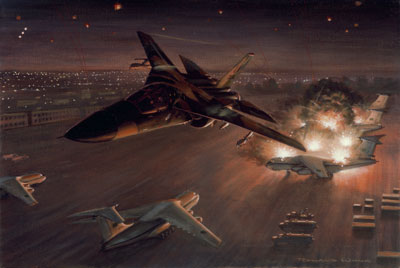
An artist's depiction of Operation Eldorado Canyon, in which U.S. aircraft attacked state terrorists in Libya with a single, high-firepower airstrike. Obama's response to the death of Christopher Stevens strongly resembles this operation.
 
The death of Christopher Stevens, the American ambassador to Libya, is a tragedy. That, hopefully, should be agreed upon by everyone. This tragedy should help us reflect on both how we interact with the world and how our counter-terrorism strategy is evolving.

We must first be clear about what happened in Benghazi. Crowds in Libya and Egypt attacked U.S. consulates roughly simultaneously. The mobs in Libya and Egypt were protesting over an internet video titled "Muhammed Movie Trailer" released by an Israeli-American Jew. The 14-minute video is an untrue, libelous and sick assault against the founder of Islam. Muslims thus ought to be disgusted by this video. The protests at the U.S. consulates seem to have been sparked by the belief that this video was broadcast on the American mainstream news media and that it reflected the beliefs of most Americans. Both of these beliefs are of course false, but what matters is not whether they are true, but how they came to be believed. It appears that an activist leaked the video to a reporter, who in turn spread it via Facebook to Libya and/or Egypt, where it quickly spread and went viral. Although the crowd in Benghazi that protested outside the U.S. Consulate was never peaceful (they scaled the consulate wall and burned an American flag), they were not what did Stevens in. The protest was infiltrated by insurgents, who attacked Stevens and his entourage with a rocket propelled grenade and automatic weapons. The insurgents possibly have links to Al-Qaeda, according to the Wall Street Journal.

There are a few things that are significant about this event. First, the fact that an insignificant video can be seen by thousands of Muslims as representative of prevailing American culture speaks to the fact that the U.S. has an image problem. Here, it is apparent that this image problem is not, as some claim, a result of the fact that the U.S.' primary means for interacting with the world is through its military. While it is true that America's main way of interacting with her enemies and neutral countries is through military force (or threats and shows of force), we no longer live in an area where states are the main global actors. Instead, groups of people, from Libya's National Transitional Council to the protestors in Tahrir Square to Al-Qaeda, are the main actors in the world. Most global individuals interact with the U.S. in one of two ways: through our culture (which includes not only our values, but also how we convey those values e.g. entertainment and the media) and our economy, namely through multinational U.S. corporations that sell to all nations, although the former is clearly more influential. While it is idealistic and pretty hopeless to ask the media to tone down the Islamophobia in order to protect American lives, it is the only real solution.

In remarks following Stevens' murder, Obama stated that he would "avenge" Stevens' death. Obama gave us a pretty clear indication of what he meant by that: two Arleigh Burke-class destroyers, heavily armed warships designed for air defense and high-volume bombardment, were deployed to Libya. U.S. drone aircraft have also been spotted in Eastern Libya, where the attack took place. So Obama is planning to crush Stevens' killers with overwhelming force. The unilateralism of this operation and its reliance on a single, highly visible usage of heavy firepower (in contrast to a protracted counter-insurgency campaign like Afghanistan or a lower-profile targeted operation like the U.S. operations in Pakistan) seem reminiscent of the approaches Reagan and Clinton took to counter-terrorism, namely to the Eldorado Canyon operation in Libya and the attack on Tora Bora under Clinton. Does this mean that Obama is changing his counter-terrorism strategy from targeted killings to overwhelming force? Probably not, since deterrence by force (aka "shock and awe") has clearly not worked against Al-Qaeda. However, it is important to keep in mind that the the insurgents who carried out today's Benghazi attack are representative of the new face of global Islamic terrorism: local groups operating under the banner of Al-Qaeda to increase their publicity and get support from both foreign donors and local recruits. With that in mind, it seems that Obama is trying to send a message to these Al-Qaeda-inspired groups, many of whom have less resolve than Al-Qaeda itself (compare how much longer Al-Qaeda in Pakistan has held out to how long Al-Qaeda in Nigeria and the Philippines have held out): if you associate with Al-Qaeda at all, you will be wiped out. If this strategy is successful, which it probably will be since it relies on basic, tested theories of deterrence, it will mean the end of global terrorism, and thus of the ability of terrorist organizations to conduct global operations like 9/11. However, it will also serve to drive local terrorist groups, especially the less dedicated ones, underground, decreasing their effectiveness. While this would make it more difficult to root out these organizations, it would also take away our rationale for doing so: that they pose a threat to our security. In other words, if this strategy and Obama's current targeted killing strategy aimed at Al-Qaeda's leadership work, it will mean the end of global Islamic terror. Let's hope it works.